
New OECD report calls for action on foundational skills
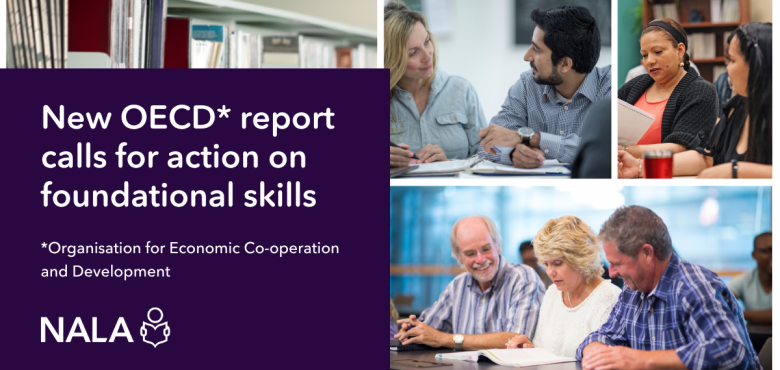
New research from the Organisation for Economic Co-operation and Development (OECD), published on 1 July 2026, shows how important the “foundational skills” of literacy and numeracy are for individuals and societies. The report says that “the challenge of low foundational skills is large, growing, and consequential” (p9) and it “sits at the heart of economic performance, social cohesion and democratic resilience.” (p3)
The OECD is advising governments to focus on bringing adults up from low skill levels into medium skill levels, which they say is both achievable and impactful – it can lead to “substantial gains” (p71) in:
- employment
- wages
- health
- life satisfaction
- civic participation
A key message of the report is that a one-size-fits-all approach will not work, because adults with low foundational skills are not all the same – and neither are the countries they live in.
What does the OECD say about Ireland?
The research finds that adults with low foundational skills in Ireland are typically “older natives from low-education families” (p59), highlighting how socio-economic status continues to drive adult literacy needs here. The cycle of inequality continues as adults with low foundational skills in Ireland earn $7.70 dollars less per hour (about €6.75 in Euro) than adults with medium skills.
The research also shows that in Ireland:
- Around one in three (29%) adults have either literacy or numeracy needs (these are who the OECD calls “adults with low foundational skills”)
- Around one in six (16%) adults have both literacy and numeracy needs
Where adults with foundational skills want to take part in adult learning but don’t do so, the main barriers in Ireland are:
- family responsibilities; and
- cost.
What does the OECD recommend?
For countries like Ireland, the OECD recommends:
- short courses that can fit around employment;
- modular, stackable pathways with recognition of prior learning; and
- active outreach through employers and social partners.
To prevent adult skills needs developing in the first place, the OECD also recommends addressing inequalities in early years education and schooling.
Find out more
Full report – Navigating Life with Low Literacy and Numeracy
Other NALA articles on OECD research:
Stay up to date
Most recent news

Sign up to be kept up to date on our latest campaigns.